10.07.2009

Dragon Dance

I posted some pictures both of the Mid-Autumn Festival lanterns and the Tai Hang dragon dance over on flickr, but I realized a little explanation was in order.

From Wikipedia: The Mid-Autumn Festival is one of the few most important holidays in the Chinese calendar, the others being Chinese New Year andWinter Solstice, and is a legal holiday in several countries. Farmers celebrate the end of the summer harvesting season on this date. Traditionally on this day, Chinese family members and friends will gather to admire the bright mid-autumn harvest moon, and eat moon cakes and pomelos together. Accompanying the celebration, there are additional cultural or regional customs, such as:

  • Eating mooncakes outside under the moon (lots of this ... we, for the record, don't really like mooncakes)

  • Putting pomelo rinds on one's head  (we didn't see any of this!)

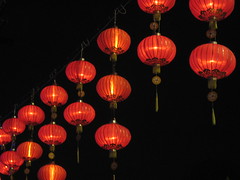
  • Carrying brightly lit lanterns, lighting lanterns on towers, floating sky lanterns (lots of this, too, though a lot of the lanterns these days are plastic and shaped like cartoon characters!)

  • Burning incense in reverence to deities including Chang'e (lots)

  • Planting Mid-Autumn trees (didn't see any of this ...)

  • Collecting dandelion leaves and distributing them evenly among family members (nor this)

  • Fire Dragon Dances (well, as a matter of fact ...)


So I've mentioned how much we like our new neighborhood, Tai Hang. And this past weekend we realized that it is home to one of these dragon dances. From the Tai Hang Residents Welfare Association's Website:

The Fire Dragon Dance in Tai Hang has its origin in 1880. Tai Hang was a small Hakka village by the sea and most of the villagers were either farmers or fishermen. They lived a simple but peaceful life. The story began in one stormy night when the villagers killed a serpent. The body of the dead serpent disappeared in the next morning. Right after a plague spread out and many villagers died of infection. One night, an old villager saw Buddha in his dream and was advised to stop the plague by performing a fire dragon dance and burning fire crackers in the Mid-Autumn nights. It might be the sulphur in the fire crackers that disinfect the village and the villagers were saved. Since then, the villagers in Tai Hang would perform fire dragon dance during the Mid-Autumn Festival every year to commemorate the incident. The fire dragon is made of stuffed straw and stuck full of incense sticks, and is 220 feet long with 32 segments.


There are lots of photos and even videos online you can google, but here are some great ones---this guy obviously had a much better view than we did!

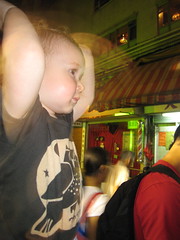
I should say that we didn't actually stick around for the whole thing ... It was getting very crowded, and late, and all that incense puts off a lot of smoke. But Finn loved the drums, he loved drumming Matt's head, and he's been talking about drums ever since. In fact, today we walked around the street where the dance had been and all he could say was "drums drums drums."

10.05.2009

Year of Asian Cinema : 3

Since last I posted we've developed quite a list of titles, thanks to your comments and emails and Matt's movie-watching colleagues. I'll try to compile them someplace so you can watch along with us ...
Now, onto no. 3.
  • Secret Sunshine - Lee Chang-dong, 2007
  • viewed on Monday night, September 28, 2009
  • Korean, with English subtitles
Our new movie rental store, like most movie rental stores here in Hong Kong, is tiny and packed to the gills with dvds and vcds. Not arranged or organized in any manner I can discern, finding a particular movie and then figuring out what it's about is tricky, to say the least. Last week I was in there with Finn, trying to get in and out as quickly as possible, and this movie had an interesting cover and had won some awards. It was almost dinner time and Finn was cranky, so even with no plot synopsis, that was good enough for me.

Well. Secret Sunshine is quite a movie to just happen upon. And though I heartily recommend it, I also think it's fair to know what you're in for. That two-sentence plot synopsis I didn't find would have read something like this: "A recent widow moves with her young son back to her husband's hometown to start a new life. Her plans shatter when tragedy strikes, and she turns to religion in her grief."

That tells you right there that any parent is going to have a hard time watching this, and any person of faith is going to be challenged by questions about God's will, forgiveness, grace, and hypocrisy among the faithful. It's intense and emotional, yes, but with a long slow burn rather than a punch in the stomach. We're still thinking and processing, a week later.

Perhaps it's not as gut-wrenching as it could be because it's a Korean film instead of an American one. The slow pace and lack of music just make it feel very real ... and grief, in real life, often takes time to erupt, with plenty of long pauses at the kitchen sink where you forget what you're doing. Matt pointed out that the Asian films we've seen thus far are even lit differently than American ones, with a cool, blue-gray realism, rather than golden-hued sentimentality. (Have you seen The Secret Life of Bees? A beautiful movie, and we love the book, but really, did the entire movie take place at sunset?)

Secret Sunshine's portrayal of Christianity is a fair one, I think. Not entirely flattering, it's not mocking or ridiculous either. The woman, Shin-ae, becomes a Christian as a direct response to her grief, and it's clear she has a lot of work to do emotionally to synthesize her grieving process with her newfound faith. It's not clear, however, that the Christians she knows will be able to help her move beyond simple answers to a more mature understanding, and I kept wishing I could tell her that doubts, struggle and anger with God are as much a part of faith as that blessed assurance is.

The scene that has provoked the most conversation between Matt and I is about forgiveness, and I should warn you now that if you plan to watch Secret Sunshine and you hate spoilers, you should stop reading. Come back after you've seen it and tell me what you think. Really, I don't want to ruin the impact of this scene, and the review digresses into theological ramblings at this point anyway. It's clear that I really just need to talk about this film some more, so please---go watch it and respond!

For the rest of you, Shin-ae decides to convey forgiveness to the man who has harmed her, and said scene is of their conversation. (Alright, so question no. 1 is---did she really need to convey the forgiveness? Could she just forgive him privately but not face him or tell him? She thinks she does need to tell him, at least in part as a witness to God's love, and maybe, deep down, out of a desire for some level of power over him, the power of offering or withholding forgiveness.)

To her surprise, she finds that he too has become a Christian, and that he has received absolution from God and feels at peace. She has the response that any of us would have, I think, and resents this. Clearly she's not ready for him to feel peace, not when her pain is still so raw. Nor is she thrilled to have even this power taken away as well.

If we are to take him at his word that he has truly become a Christian, which is really all we can do, then we have to accept that he's in the same position that she is, spiritually speaking. Both in psychological torment, both need immediate relief, both find relief in religion. And as she feels a need to forgive, he feels a need for forgiveness. After their conversation, we are left wondering if the forgiveness was real---both what she offered and what he felt from God. Did the fact that she still wanted him to feel some pain mean she wasn't really ready to forgive? Did the fact that he already seemed free of pain or guilt mean that he hadn't really faced what he did, and thus maybe God's forgiveness of him wasn't real?

I see forgiveness as more of a process than an event, and this understanding shapes my view of this scene. Her forgiveness was real, just not complete. When anger or pain is still fresh, even the desire to forgive counts. And even though it wasn't too early to want to forgive, it probably was too early to see him. She'll need to forgive again and again, as new layers of anger and grief emerge. And as for the forgiveness being mixed up with some superiority or desire for power, that's pretty real for us humans.

Likewise, his absolution and peace are real (again, if we take him at his word), much as I hate to admit it. I may think this guy eventually deserves forgiveness (or at least I can accept God's forgiveness of him) but I certainly don't think he deserves peace ... not yet, anyway. God, however, extends grace to all of us, deserving or not. I'm trusting that as time passes and he grows in faith, he will grow in compassion. His understanding of his sin will grow, and he will likewise need to seek forgiveness over and over again. Not because God's forgiveness wasn't complete, but because his own repentence wasn't. Again, forgiveness is more of a process than an event, and God forgives to whatever extent that we can repent. Just as Paul tells us to "work out our salvation in fear and trembling," (Philippians 2:12) we work out our forgiveness, in just as much fear and trembling.

In Secret Sunshine we get to watch some of this working out, and it's not at all clear where Shin-ae will end up. Our preacher this past weekend reminded us that the larger meaning behind the cliche "Amazing grace" is that grace puts us in a maze. It is bewildering, it makes us feel lost and unsure where to go. The lame walk, the poor are fed, and yes, the undeserving get forgiven. Of course, Shin-ae is already in a maze, put there both by random bad luck and intentional violence. She thinks Christianity is her straight path out of that maze, but it just doesn't work that way. As a believer myself, I have every hope that somehow God's peace will sustain her through the coming hard days, and will be there, waiting, when she is ready for it.
10.04.2009

Health Care: a quick update

A quick update regarding maternity care in public vs. private systems in Hong Kong.

Were we to have a baby here, a priority for us would be to have the best possible chance of a natural delivery, with few medical interventions. (And lest you think I'm just trying to be a super-woman, this is as much because I'm a total scaredy-cat when it comes to hospitals, needles, IVs and the like as it is anything else.) What I've heard lately, in several conversations with women who've delivered here, is that for my goal, the public hospitals are the way to go. This is entirely anecdotal, and our speculations about why this is so are just that: speculations. But for what it's worth, here they are:

1. Cost. C-sections are expensive, flat-out. So in the public system there's no incentive for doctors to push for one unless truly necessary. Of course the fear is that doctors might encourage against one even when necessary, but nothing I've heard would suggest that happens here. They also don't hold out on medication for women who want it.

2. Doctors. In public hospitals, you see a team of doctors for pre-natal care (called ante-natal care here, but that always confuses me) and whoever is on call catches the baby. In the private system, you pick a doctor for all the prenatal care and the delivery, and so they have every incentive to encourage scheduled c-sections and to speed up labor that isn't fitting well into their schedule.

3. Population. Rates of scheduled sections are very high in the private hospitals, and this likely has something to do with both the doctors who work there, and the women who use the private system. Have to be wealthy, likely to be busy, working at an executive or managerial level, have a short maternity leave, etc.

4. Trickle effect. When the majority of women get scheduled sections, nurses and doctors don't get as much practice at helping women have natural, non-medicated births. They don't know what positions to suggest, they don't have as many tricks for helping with pain relief, and they don't always see or have experience with the wide range of "normal" in labor and delivery.

Let me be clear that this isn't to suggest that birth in the public system is always rosy ... laboring in the ward sounds horrendous to me, and I've heard very mixed reports on the amount of labor support you get from the nurses and midwives. But still, I was surprised to hear that for a natural delivery, the public system can be a better option.

9.20.2009

A Year of Asian Cinema: 1, 2

We've committed ourselves to watching Asian movies this year ... because they are readily available on every block, because there are thriving film industries in Hong Kong, India and Japan, and because we'd like to delve a bit more deeply into this place we're living.

I'm going to chronicle the movies we watch here on this blog. Film reviews aren't nearly as interesting to me as restaurant reviews and book reviews, but I at least want a record of what we watch and what we like. So here goes.

  • Departures, directed by Yojira Takita, 2009

  • Viewed on a rainy Sunday night, August 30, 2009

  • In Japanese, with English subtitles


Filled with lovely music and beautiful images, this film satisfied on many levels. An out-of-work cellist returns with his wife to his hometown and the house his mother left him. He begins to work in a funeral home, helping to prepare the dead for burial, and helping the living to grieve. It's not popular or respected work, but he grows to see it as something of a ministry. The movie is a bit predictable, but even as you know where it is going, you don't want it to go anywhere else. A certain Japanese quirkiness and humor keep it light, and themes of the nature and purpose of work, and what makes work meaningful, resonate with us right now. Just lovely.

  • The Way We Are, directed by Xu Anhua, 2008

  • Viewed Sunday night, September 7, 2009

  • In Cantonese, with English subtitles


Sweet, subtle, and maybe a bit slow, The Way We Are portrays a friendship between two women of different generations who work in a supermarket, each alone in her own way. (The slowness is fine with me, since it allows me to knit, even with subtitles!). Their friendship is evidence of what Bobby Ives says about people---every person you meet has something they need from you, and has something to give you. For us it was an insightful, detailed glimpse into the everyday lives of real Hong Kongers, and we loved recognizing the scenes we've observed right on our street. The younger woman of the pair reminds us of our favorite doorkeeper, but I think we would have gotten attached to both women even without that. More complex than it seemed at first, the movie deals with themes of family, religion, and the intense human need for someone to love. The Way We Are doesn't make any simplistic moral judgements---being poor and hardworking doesn't necessarily make one more happy or more righteous than a wealthy person, but neither is the opposite true.

9.18.2009

Moving ...

We're 10 suitcase-loads, 4 backpack-loads and 6 tote-bag loads in, and that covers all the books except for a few of Finn's, most of the clothes, most of the toys, and 3/4 of the kitchen stuff.

I've had this crazy idea to move without boxes, and that's basically what we've done. What I find so tiring about a move is all the days spent surrounded by boxes upon boxes, on both the front and the back ends. So since we had a week of overlap between the two apartments, and since it's really quite close--a short and cheap cab ride--what if we just shuttled suitcase loads back and forth, putting stuff away as we unloaded it? It's working so far, in large part because the new place is furnished, so even before we move our furniture there are shelves and drawers to contain what we bring.

It's a lot of work, to be sure, but I'm thinking it's a bit saner overall. Basically Matt takes a load over on his way to school, then Finn and I bring another load later in the day. We then unload and put away the day's delivery, and take the empties back home. We still get to go for walks, go to the pool, eat dinner at home, watch movies, AND we're not tripping over boxes!

I have, of course, primarily spent the week feeling nostalgic and sad about leaving this flat, despite my initial misgivings last year. I'm always sad to leave a place I've lived in, no matter how short a time, and no matter how much (or little) I liked it. If I've lived there, then things have happened there--I've felt feelings, imagined futures, eaten meals, laughed and cried. Books and recipes get imbued with the place in which I read them or cook them, and when I return to those books or those meals, details and senses from that place come flooding back.

And so it is here: Swedish pancakes will forever remind me of learning to cook in our wok, Finn has learned to crawl, to stand, to speak here, Obama was elected here, and The Wire is for me as much about dumplings on our tiny bed in Hong Kong as about gangs in west Baltimore.

It's our last day here, so you'll have to forgive a bit of sentimentality, as I think about all the things I will miss about this place. Generally it's the little things, the physical details that take time to get noticed, that linger longest. Things like:

  • Lovely evening light on our terrace

  • A well-lit kitchen--pleasant enough for late-night wash-up, bright enough for chopping.

  • A well-lit bathroom--pleasant enough for mirror close-ups, bright enough for reading in the tub.

  • Kitchen cupboards that open to reveal sunny yellow interiors.

  • The cleaning pleasures of built-in beds--no dust bunnies under or around.


And then we come to things I'll miss about our building. We've been a bit embarrassed at times about how luxurious this building is, and though we haven't lived here long enough that we need these luxuries, we sure will miss them.

  • Regular night swims after dinner. My summers in Canada and years in New England taught me to love swimming in lakes, ponds and rivers, and even to disdain (a little) chlorine. But swimming at night, with underwater lights in a variegated green-tiled pool, is simply lovely.

  • Decorations for every holiday and every season. Right now, there are lanterns galore for Mid-Autumn festival. The decor is mostly tasteful and a little tacky, but always cheerful. As one who thrives on rhythms, routines and traditions, I love living in a place that decorates.

  • And lastly, our wonderful doormen and women. Leaving them just about breaks my heart, as ridiculous as that is, given that I only know the name of one of them, and he, likewise, only knows Matt's and Finn's names, but not mine. They are, nonetheless, chief members of the small club of people that Finn knows on sight and runs to greet. They are the closest thing we have to neighbors--people who see us everyday, and probably know more about us and our lives than we realize. Some days last fall, their smiles and small talk were the only contact I had outside of my family, and I took refuge in their kindness. (And just to be clear, this small talk generally consisted of only a very few words: "raining," "going shopping?" "swimming?" "hot," "very hot," and most often, "oh, good boy" or "very good boy").


Right now I am taking refuge in knowing that as surely as I feel sad today, I will feel sad when it comes time to leave our new home. New lovely details will give our days beauty, new scents and sights will mean "home," and new neighbors will delight in Finn's smile and commiserate with us about the weather. Goodbye, flat 18E, 632 King's Road. We pray that some of our happiness here has seeped into the walls and will bless whoever sleeps here next.

9.15.2009

Health Care: a view from Hong Kong

I know everyone is talking about health care reform these days, and while I'm sure you can guess that I strong opinions on this, I'm going to save those for another day. Instead, I just want to offer a few observations from Hong Kong, which has both a public and a private health care system.

When Matt was in the negotiating stage for this teaching job, I was still pregnant. We asked to look at the insurance policy, wanting to understand the health care we would have here. We were told it was a very good policy, but we were shocked when we read that it didn't cover well-baby visits, vaccinations, maternity care, or any services for congenital health problems. We decided to accept the job anyway, but with the private caveat that if Finn was born with any health problems, we simply wouldn't go, since insurance wouldn't cover it.

And then we got here, and I was asked the very first week by a fellow teacher's wife if we decided to get the insurance coverage for Finn and myself. (The employee is fully paid for, we contribute for the family coverage.) I truly thought it was a silly question and said "Of course," wondering what kind of irresponsible mum this was.

And she, on the other hand, a Chinese-Brit, with Chinese frugality and the experience of the NHS, thought that I was the irresponsible one, paying for expensive coverage I may or may not need, when the government offered more-than-adequate care for free.

What a wake up call! I knew, of course, intellectually, that other countries have other ways of providing health care. I knew that other countries offered universal coverage. But the idea of needing insurance in order to get health care is so deeply ingrained in me that when making decisions for our family, I couldn't imagine anything different.

And not until last spring did I understand that, in many instances, the public health care offered is actually better than private. The reason that insurance doesn't cover congenital health problems is that if you have any complications with your pregnancy or delivery, and if the baby is born with any problems, you are automatically transferred to the public system. That's where the best equipment is, the latest technology, and the best specialist doctors.

We were told last year that we should choose which hospital we would want to go to in the event of an emergency, as the ambulance drivers won't choose for you. And when we asked around for advice, we were told consistently that for an emergency--any kind--the public hospitals are where we would want to be.

As far as I can tell, the major difference between private and public care--besides cost, of course--is comfort. In private hospitals you pay at different levels for a shared room or a private one. The food is better. Visiting hours are longer. You may or may not get better nursing care. In public hospitals, you pay virtually nothing for a ward room, then you can pay for shared rooms or private ones.

Comfort is not an insignificant issue, of course. And I'm not in love with health care here, but it's due to cultural issues rather than quality, and all of our experiences thus far have been with the private system. We don't plan to have a baby here because many of the attitudes around birth and support for breastfeeding aren't what we want--but that's true in both public and private settings. When asking women who have given birth in the hospitals here---public or private---about their experience, a common response is "Oh, it was fine. I was able to get an epidural right away." (!)

I would love to find out the cost comparison between health care in the two systems--not the out of pocket cost, or what the insurance pays, but the cost of the health care itself. What relationship does cost have to quality? And how do we decide what "quality" is?  I guess those are questions, aren't they ...

We're about to begin our foray into the public system. Tomorrow Finn will have his 18-mo check-up and vaccines at the Anne Black Maternal and Child Health Clinic, right here in North Point. So far, getting an appointment was painless and quick (called Monday, appt. set for Wednesday.) I've heard that the developmental checks are longer and more thorough at the gov't clinics than with private doctors--I'll let you know.

update: The appt. today was fine, with a much more thorough development check--felt like the well-baby visits we had back home. The entire visit was much more "specialized"--there are designated nurses (and rooms) for the measurements, the interview (this is the developmental part, with a nurse), the consultation (this is the physical exam by the doctor), and the vaccines (they call it The Injection Room). Of course, there is a bit of a wait in between seeing all these folks--the entire visit was 2 hours, and I estimate that we were seeing someone for 1 hour of that time, and waiting the other hour.

Contrast that with our visits to the private doctors: Probably only 45 minutes total, but only 15 minutes seeing someone, the rest waiting.

9.09.2009

Tai Hang

Last week I picked up a copy of HK Magazine--one of those free, urban weeklies--and found that our new neighborhood, Tai Hang, was featured. This was both good news and bad news. Mostly, it was fun to realize that we still have our cool-neighborhood-instincts. We stumbled onto Tai Hang last year and fell in love, knowing very little about it but instantly attracted to its feel, and to its "unknown" status.

So that's the bad news--not so unknown after all! Why is it that we like to think we've discovered something, like to think our ideas, leanings, attractions and desires are completely unique? It's humbling to remember that we really are products of our generation, that as counter-cultural as we think we are, we are very much living in this time.

Humbling, yes, but ultimately reassuring too---sharing these things just locates us firmly as part of a community. So we're still very much looking forward to exploring Tai Hang and claiming it as ours---for a time---even if we're doing it with lots of other Hong Kongers. (The counter-cultural ones, of course, the ones who also think they've discovered something. I'll pretend I don't notice you if you do the same ... and how about a secret handshake if you'd like to meet up for coffee?)

night view

the view from our (old, current) apartment ... could anything really be hidden or "unknown" in this city?