Showing posts with label HK Alphabet. Show all posts

3.01.2012

HK Alphabet :: V

V :: Victoria Park
(photo by mikeleeorg)

August 3, 2008: Matt and I, our five month old baby, and 5 large suitcases got off a 14-hr flight and rode a shuttle to L'Hotel (pronounced locally "el-hotel"), where the school put us up for a week while we found housing. Right in the heart of Tin Hau, a neighborhood we came to love and later live in, on the edge of Causeway Bay, a bustling shopping and nightlife district, and across the street from Victoria Park, a sprawling oasis, this hotel was perfectly situated to aquaint us with our new home. But we didn't know that then. It felt sort of dirty to us, and commercial--not at all residential or peaceful. (What, you might well ask, did we expect in Hong Kong? Good question.)
And the park. As much as we enjoyed watching people play basketball and tennis all day and night from 20 stories up, the park's strangeness struck us most forcibly. So much concrete! So much landscaping! So little grass! We walked across the park in search of dinner that first night, both of us quiet, neither one wanting to admit that we couldn't imagine what we had been thinking, how we had made this colossal mistake. Until we did admit it, and found relief and laughter in the common question.
And then, slowly, things began to change. The park became familiar, and eventually a refuge. The playgrounds there are where Finn learned to climb, to swing, to run and to ride his bike. We made friends there, became part of a crew of kids and helpers who came at the same time.
We discovered the lone patch of grass in Hong Kong and took Finn there for soccer and frisbee, and we found rogue bits of dirt for Finn to play in, notwithstanding the disapproving looks and even reprimands from the old Chinese ladies. I ran around the jogging track in the evenings, and I admired the old people doing their tai chi. We found the motor boat pool, we saw Venus Williams warming up before a tournament, we went to flower markets and moon festivals and June fourth celebrations there. And we learned to love Sunday afternoons.

Sundays, you see, are when domestic helpers get a day off. But without a place of their own to gather in, they descend in large numbers on Hong Kong's parks, gathering with friends, sharing meals, passing the time. Victoria Park was a destination primarily for the Indonesian helper community, and the grounds--concrete walking paths, playground, soccer courts, grassy field--were literally covered with plastic tarps and women. Women lounging, sleeping, playing cards, playing guitar, singing, chatting, fighting, sharing their food, reading. Groups of Muslim women would kneel and chant, Christian women would sing and preach. Rebel-types would practice hip hop dance moves (which Finn loved and tried to imitate, much to our embarrassment and their amusement.) Most of the women were physically affectionate with each other, as is normal in their culture, but there were some with stereotypically "butch" haricuts, masculine clothes and foul mouths that seemed to particularly luxuriate in Sunday's freedoms. Some young women carried around large, beautiful dolls, that they dressed and groomed much as I did as a child.

I'm writing this now from Ohio, and we have a few nice little parks we visit, all with playgrounds, and some with walking paths, lakes, or basketball hoops. None of them, however, come close to having the sort of life and vitality of Victoria Park, a vitality unique to urban parks, I suppose. It was a vitality that often saved me as a new mom in a new city, offering contact with people, no matter how anonymous, when that is what I most needed.

2.20.2012

HK Alphabet :: U

Yes, I'm returning to this series to finish it up. Most of the remaining letters are already written, and inexplicably unfinished or even just unposted. So here we go, returning to June of 2011, when this was actually composed.

U :: Umbrella

Rainy days in Hong Kong can be really rainy. And crowded streets in Hong Kong are really crowded. Put it together, and you get scenes like this:
Though it can be a little dangerous in there--a little crazy--it's also cozy, and I love how people synchronize their movements, raising an umbrella here, holding it close there, all weaving together and avoiding accidents. Watching it--and staying dry!--from the second story of a bus is a great treat of rainy days, all the beautiful colors dancing in a moving canopy.

U :: Under bridge spicy crab
You can hardly tell what's under there, but it is crab. And what's hiding it is the most deliciously obscene amount of fried garlic and chilis (but mostly garlic) that I have ever seen, much less eaten. Needless to say, this is not for the faint of heart. Or maybe it is, because isn't garlic good for the heart? It's certainly not for the faint of nose, anyway. But it is delicious, and so is the crab, though it becomes almost an afterthought to all that perfectly fried garlic. There are a few restaurants that specialize in this dish, also known as "typhoon shelter crab", and they are all located--you guessed it--under a bridge.
We did our best, but couldn't even begin to finish off the garlic.

6.29.2011

HK Alphabet :: T :: Tea-drinker, tailor, trams go by ...

T :: Tea
Our first year here, I found myself in an enormous, industrial-sized lift, going up to the 12th floor of an old factory building on Shipyard Lane. Next to a noisily functioning printing press, I found an oasis of beauty and quiet, all dedicated to the art of tea. I was at the time--and still am--a tea amateur, knowing very little about what makes for artisan-quality tea.
(photo by Chip Smith, my brother!)
And yet, I have become sufficiently enamored with the process of brewing and enjoying tea, Chinese-style, and I have enough respect for anyone with this much dedication and passion for a gustatory pleasure, that I was instantly in love. Vivian, the owner of said oasis (Ming Cha teahouse), trained as an artist in Chicago and lived there for awhile before coming back and pouring all that training into the harvesting and sharing of good tea. And now, hers is the first tea to be included in a Slow Food Convention in Italy.
I drank tea with her, and we talked. I eventually took a class, learning how to taste and evaluate the aroma, color and flavor of tea. I learned about monkey-pick tea (it's a myth) and discussed the pairing of chocolate and tea. We even discussed my making pastries for the tea shop, paired to match the teas. (Which would have been great, but the logistics just never worked out.) 
And while I'm glad for the knowledge--what little of it I've retained--it is still, for us, all about the simple pleasure of making and sipping tea. We have a favorite tea house, and the gentle, calming rituals of the servers never fails to soothe. It's the attention to small details that is so comforting, I think--the precise temperature of water, of cup, of tea; the washing and rinsing of the tea leaves, of the cups and the pots; the abundant pouring of water ("filled to the brim and even over the brim"). And then, of course, the tiny cups, so that all that work and attention is magnified instead of lost, as it would be in a mug. The whole process focuses and magnifies our attention as well, so that it is impossible to continue in a conversation or send a text or even read. It is, quite simply, a wonderful way of being together with another person--the pouring, steeping and sipping of tea. 

T :: Tailor
Hong Kong is famous for its tailors, particularly for men, and many advertising the famous 24-hour suit. Even though having a suit made is considered a "must-do" for tourists of a certain stripe, it's something the locals do as well. We've sent visitors out to experience it before, but we've only just now gotten around to doing it ourselves, since Matt will be sporting a coat and tie daily in his new job.
He tried both the tourist version (pricy, good English, comfortable storefront and ample discussion of the options) and the local version (minimal English, little discussion, hidden away and cramped storeroom, much less expensive.) We don't know the final results yet for the suit and jackets, but Matt is a convert on the shirts. Even though it's no less expensive than buying shirts off-the-rack, I'm not sure he'll be able to go back. No matter, since a feature of all these tailors is that they retain your measurements indefinitely, allowing you to call and order more to be shipped overseas. Some even take worldwide "tours"--stopping in New York and Paris and Rome--for measurements to be updated. Which means that I think we have future presents for Matt all sewn up.

T :: trams
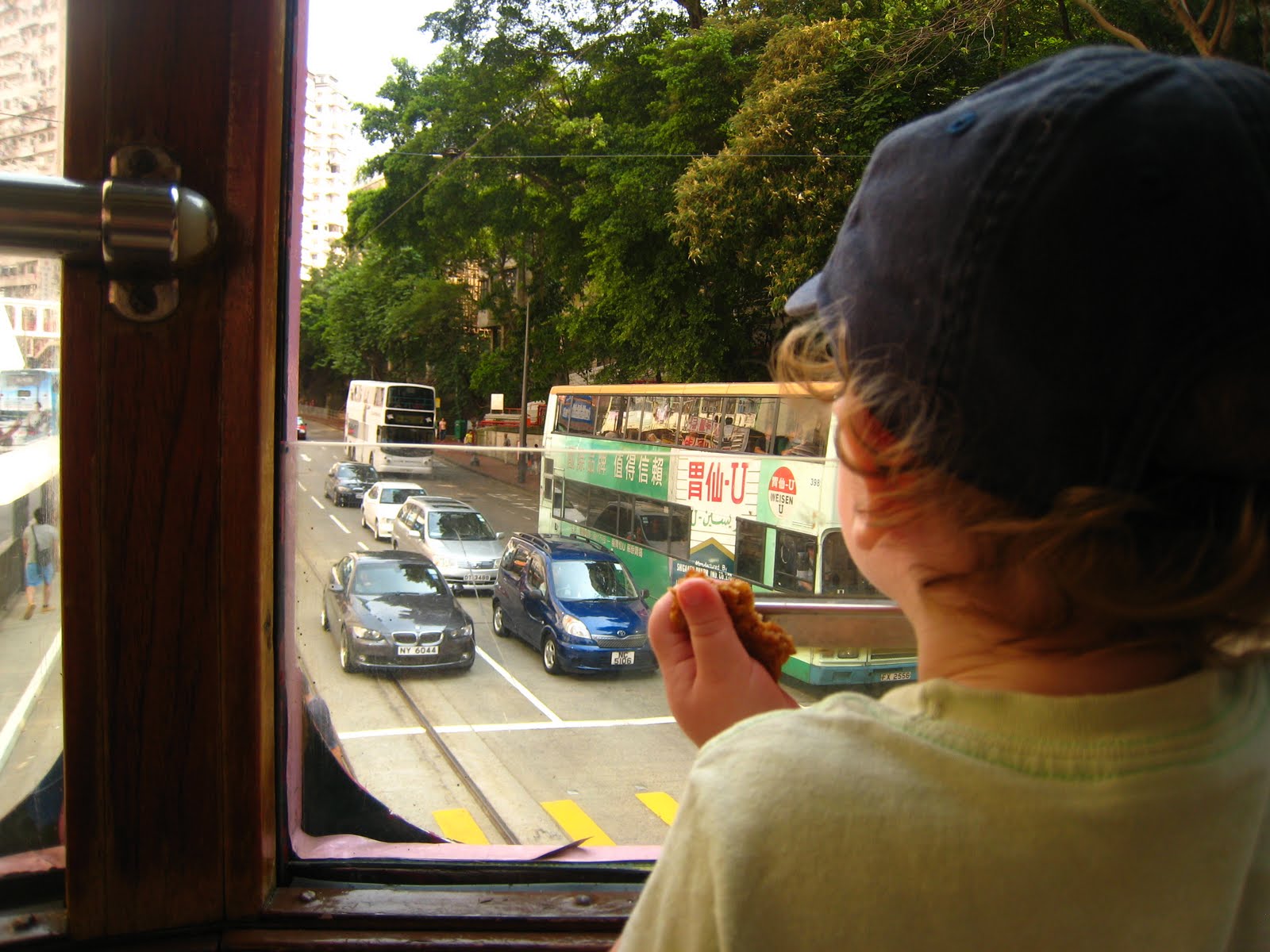
The tram is yet one more slow form of travel in Hong Kong that we love, particularly for all it's anachronisms: the little bell, the wood, the slow, slow pace, and the low, low price. It's easy and direct, though, and if you can ignore the fumes from all the traffic below, it's a very pleasant way to see the city.

T :: 23
I know, I know, "T" has been epic. Enough already, huh? But I need to give at least a slight nod to the 23, our favorite busline in all of Hong Kong, the one that has shuttled us back and forth to church, to HK Park, to friends' homes in the mid-levels, and to all those baby classes Finn and I took our first year here. He has logged many hours of naps on this line, and looking out the second-floor windows, with a sleeping child on my lap, is how I discovered this city. 

6.28.2011

HK Alphabet :: S

S :: Star Ferry
To get from Hong Kong Island over to Kowloon, you have several options: road (underwater tunnel), train, or the Star Ferry. Guidebooks regularly call the Star Ferry "one of the most scenic ferry crossings in the world" or some other such superlative description. I don't know if any of that's true, having little basis for comparison. But I do know that any chance I get to ride on the Star Ferry, I take it.
First, some geography. Not everyone realizes that Hong Kong proper is actually an island, while Kowloon and the New Territories are on the mainland. (Mainland China, that is.) Lantau, Lamma--these are also islands, and there are some 200+ more. Which means that there are lots of ferries plying Victoria Harbor and the South China Sea, along with sampans, junks, and yachts--all of which we have had the great pleasure of enjoying in our years here.
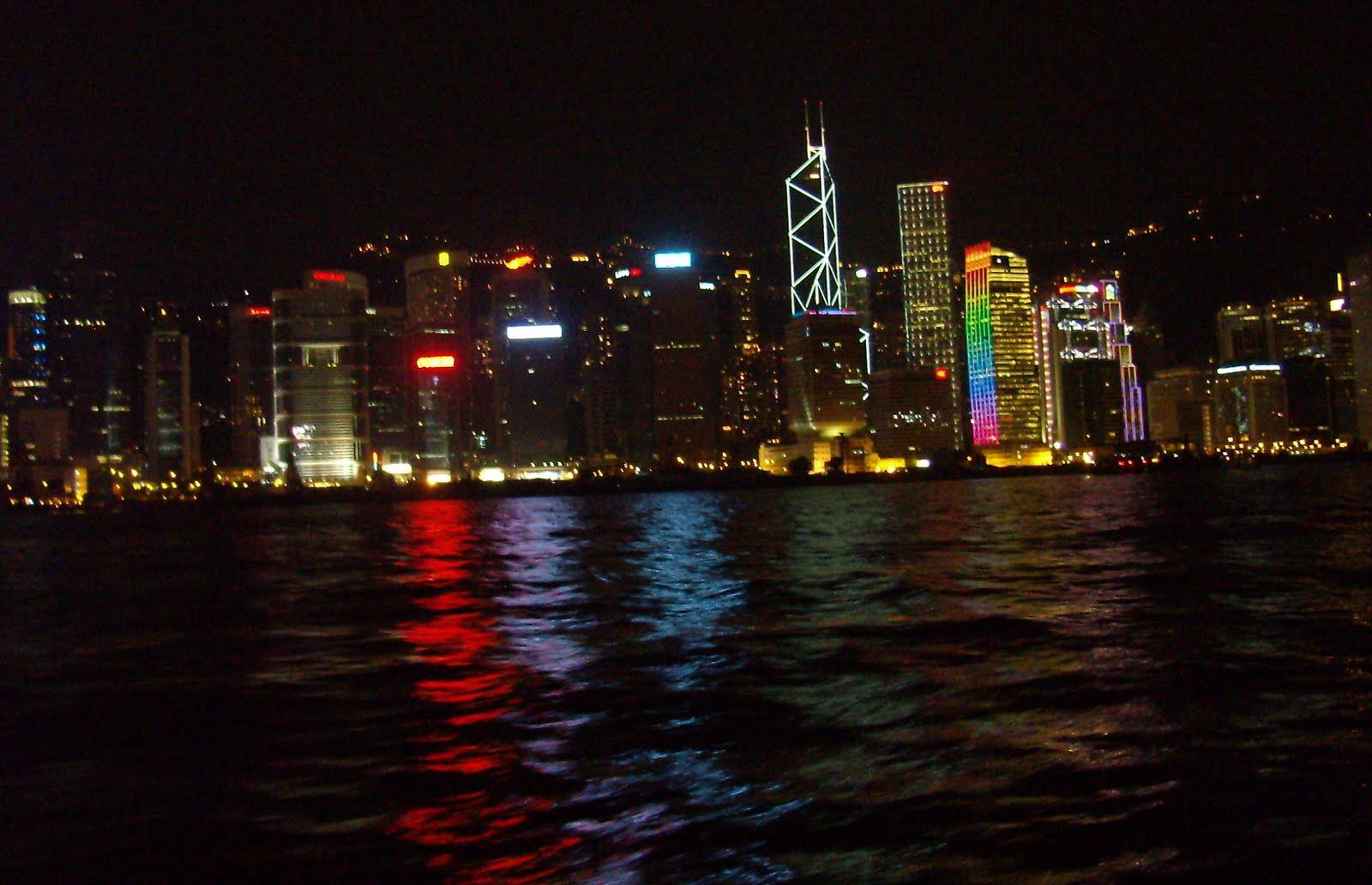
But the Star Ferry is special. Perhaps because it is not primarily a pleasure boat, but simply a means of transportation, a commuting vessel. (Once upon a time, of course, it was the only option for commuting across the harbor.) And what a way to commute! A few minutes of slow travel, a few minutes of gentle lilting and a beautiful skyline.
It is, unfortunately, but a few minutes. It used to be longer--20 minutes, at least, when my dad used it for his daily commute 40+ years ago. But they've been reclaiming land like mad, growing Central out into the harbor, and so consequently the ride has gotten shorter and shorter.
The boats themselves are lovely too, as from a different, more gracious era, from the stars on the seats to the wood floors. But my favorite feature on these iconic green and white ferries? The seat backs that flip back and forth, so that you can always face front, no matter which way the boat is going. And while there is certainly value in a rower's claim that you can only steer your course by watching where you've come from (as this blog, in fact, helps us to do) there is equal validity in facing the future boldly. And perhaps for me now, in these days of nolstalgia and farewells, facing front is what I most need to do.

5.10.2011

HK Alphabet :: P

P :: Pineapple buns


In the dark early morning, Matt arrives just as the buns are pulled from the oven, and he gets a fresh one for the bus up the hill to school. There is nothing particularly remarkable about pineapple buns--squishy white bread with a sweet, crunchy topping--nor do they taste like pineapple. (We kept buying them from different bakeries when we first moved here, determined to find one that actually tasted like the name. Then we realized the name is all about the visual--but of course! They look exactly like pineapples, don't you think?) They are often served in little cafes with an insanely thick slice of butter inside--I was sure the many pictures we saw on menus actually showed cheese until we bought one. Sure enough, it's a butter sandwich they serve.

So why do I write about this bun I've never attempted to recreate at home? (Though if I was to try, I would go in the direction of the Mexican "pan dulce" rolls.) Pineapple buns are one of those things--like milk tea, like "pork chop crispy bun", like egg tarts--that are so iconically Hong Kong we just might end up sighing over them, wanting them more when we're a million miles away than when they fuel every morning. Which is exactly why they are fueling so many mornings right now, and why I've drunk more milk tea (or more colorfully, "pantyhose tea") in recent months than in our first two years.

It's not a glorious food experience, to be sure. But it is right now, and that's good enough for me. 

P :: HK Post

There is much to love about the HK Post. Surprisingly low prices, for one. You can mail any size envelope all over Hong Kong for $1.40 (about $.18 US). And a letter back to the US is only $3.00 (or $.38 US). But more than that, I love it that packages are still wrapped in paper and tied up with string. I love it that they still use stamps that have to be licked (though a Hong Konger would never lick a stamp), and that the postal clerk scribbles the various stamp amounts on a piece of scrap paper, then totals it on a calculator for me. I love it that he then flips though an old notebook with cardboard dividers to find all the various denominations of stamp needed, and that sometimes an envelope will end up half-covered with stamps. I love it for its surprising simplicity in a city that is surging ever forward, fast-paced and high tech. I love it in the same way that I love seeing a delivery man carrying fuel tanks on a bike, or a construction worker carting debris in woven wicker baskets, or a park maintenance person sweeping with a branch broom. And maybe I am romanticizing these bits of nolstalgia--but the anachronisms delight me, jolt me into awareness, and remind me that always, always, there is more than one way to get a job done. 

4.18.2011

HK Alphabet :: O

O :: Oranges

You may see them tucked into a corner on the ferry pier or hidden in the shadows of an alley. Sometimes they sit prominently outside the door to even the most modern, Western shop. But I suspect I miss most of them, on their red plates, in front of urns overflowing with ashes, quietly offered to the ancestors in hope of blessing.

I read once that Hong Kong has the highest per capita consumption of oranges in the world, but I don't know if that's true. If it is, it's certainly due to all the offered oranges. (I do wonder, though, if the oranges have to be eaten in order to count in this statistic. And did they figure in the ancestors too?) (Our neighbor's ancestors seem to be more fond of saltines and cigarettes than oranges. Try explaining to your toddler why there is a pack of crackers on the little altar next door.)


What is true is that I can't imagine a Hong Kong winter without a particular kind of little orange, sold with the leaves attached. I don't know what they officially are called—tangerines? Mandarin oranges? We call them the perfect toddler food—easy to peel, easy to eat, self-separating into little bites. Little jewels of sunshine, every one a gift on those dreary days from December to February.

O :: Octopus

The Octopus is an aptly-named card that allows you to go to work, buy lunch, buy afternoon coffee, get groceries on the way home and not carry a bit of cash, nor worry about losing a credit card. It's an indispensible cash card accepted most eveywhere. As a three-year-old, Finn has proudly joined the ranks of kids wearing their cards around their necks, ready to swipe whenever they get the chance. Our friends discovered the hard way that vending machines accept Octopus, after their son gleefully got Coke after Coke, thrilled with his newfound power. We're trying to keep Finn away from this particular joy ...

2.25.2011

HK Alphabet :: N

N :: Noodles


No, noodles are nothing new, nor are they unique to Hong Kong. But they have been a significant part of our diet while living here, and they are a significant part of what sustains this city. (Noodles and cell phones. There'd be a revolt for sure if these two items ever became unavailable.)
There's Vietnamese pho--savory and rich, perfect on these drizzly cold days. Japanese ramen, with boiled eggs and fried pork and a light dashi broth. Coconut-rich Laksa. Wonton noodles, with just the right amount of chew and delicately wrapped shrimp. Pad Thai. There are fresh noodles in the market, hand-pulled noodles at the Shanghainese restaurants, and "cup" noodle at the beach (and virtually everywhere else. I doubt one could ever be further than 50 feet from a source of cup noodle in Hong Kong). There are more flavors of instant ramen than you've ever imagined. And in just a month or two, we'll be hitting the cold udon and the Vietnamese bun and the sesame noodles hard.

Part of what we love about noodles here is what they signify--a multicultural city where it's possible to get almost anything you want, and to get it cheaply and quickly. Noodles are the ultimate take-away food, and Hong Kong the ultimate take-away city. They work well together. And even though sometimes we hate how fast-paced and removed Hong Kong is from the land (you may only be 50 feet from a source of cup noodle, but that noodle is way more than 50 feet from its source), we do love the noodles.


N :: Names

Billionaire Lodge. Prosperity Plaza. Tycoon Court. Sincerity Building. Wealthy House. (my favorite) Effectual Building.  What more is there to say?


find previous HK Alphabet entries here

9.22.2010

HK Alphabet :: M

M :: Mooncakes

photo by visualdensity

or Mid-Autumn Festival, which is today and which is also the occasion for eating said mooncakes. Mooncakes are one of those Hong Kong delicacies that we have tried to like, but just can't. They are beautiful, little molded cakes with characters on top for words like harmony, or the name of the bakery that made them or the type of filling inside. The problem is that they are heavy, rich, and typically filled with things like lotus seed paste and a preserved egg yolk (to represent the moon.) The other problem with mooncakes is that they are truly considered a delicacy and are well-loved by Hong Kongers. They also aren't cheap, so if someone serves you one, you really need to choke it down and try to be positive about it. People queue up 12 deep to get these bad boys—bakeries, grocery stores, any stores selling food were all swamped this past weekend with people getting ready for the festivities. It reminded us of going shopping the week before Thanksgiving, and of the lines for pies at King Arthur Flour. (Just now, I'm sitting in a coffeeshop in an office park, and it's 4 pm, normally a quiet hour. Today, though, streams of people are flowing past, headed to the trains, with that happy pre-holiday chatter in the air. Tomorrow is a public holiday, and offices must be closing early. It really feels something like Thanksgiving.)

The Mid-Autumn Festival itself is a delightful holiday, celebrating the harvest moon (though why it's called Mid-Autumn, I don't know. Isn't this the first day of autumn? Not to mention that it still feels like summer, and will for weeks yet … ) Families typically go someplace in the evening to watch the moonrise, light paper lanterns, and eat mooncakes. It's also when the Tai Hang dragon dance takes place, which Finn is eagerly anticipating (dragons and drums and incense, oh my!). 


We've hung our lanterns and Finn made one at playgroup, and we've been gifted with several of the “gweilo” mooncakes which I think we'll have no trouble choking down: the Haagen-Dazs ice cream version (yum), and a slightly more traditional version made from glutinous rice (which may not sound like much of an improvement, but believe me, it is.) Now if only the weather would clear up (so we can see the moon) and cool off (so we can pretend it's actually autumn).  

9.19.2010

HK Alphabet :: L

L :: lychee


Lychee is a fruit that comes into season in late spring/early summer, just when the rising heat and humidity makes its juicy sweetness so rewarding. With a rough brownish-reddish skin that conceals a translucent white flesh, eating lychee is a messy experience, one that is best fully attended to, preferably around a table after a meal. Part of what I love about it is that it is so demanding—you can't snack on it while knitting, say, or typing on the computer. You just have to set those tasks aside, no matter how enjoyable, and give yourself to the task of eating lychee.
Peel back the skin, trying not to think about that snake you saw on the path earlier in the day whose coloring matches the lychee's exactly—the snake who was either so busy or so invincible eating his mouse that even the barking dogs up ahead hadn't scared it away. Pop the whole golf-ball sized flesh into your mouth if you're brave like that snake and don't want to risk losing even a drop of juice, again not thinking about your toddler's newfound love for exploring the bushes and straying from the path. Or you use your fingers to break open the grape-like flesh and dig out the seed, letting juice run down your arms and all over the table before indulging in the seedless delicacy, and decide that hot weather (read: snake season) is better spent inside eating lychee than out on trails anyway. 

Lai chi is also, by the way, the name of the street where we now live, or perhaps it's the area or neighborhood. We can't quite tell. Our official address is on King's Road, but the actual building is on an alley one block over. A taxi driver told us in our first week here that we should say “lai chi” (pronounced the same as lychee, except that the emphasis goes on the first syllable instead of the second--I think. I still have been laughed at by at least one taxi driver for saying it—according to him--the same as the fruit) and then they would know where to bring us. It mostly works, except that they never seem quite ready to turn where they're supposed to, so I'm not sure if it really means what we think it does. We've heard that there used to be a famous nightclub back here called “lai chi”, and that's where the name came from. Our building is called Lai King, and the neighboring building is called Lai Wai, so there must be something to it. In the meantime, I keep saying “lai chi,” hoping to sound confident and keep the questioning, final, rising tone out of my voice, which (I think) is what causes it to sound like the fruit. And I've always made it home so far. 

2.15.2010

HK Alphabet :: K

K :: Kung hei fat choi! (Congratulations and Prosperity!)


How fortuitous that K just happened to be next up ... this has to be an auspicious sign, yes?

Chinese New Year is a holiday I am so glad to have gained. It's a gift from Hong Kong that I know will be part of our making-it-through-winter-until-spring rituals for years to come. We may have to youtube a lion dance rather than be woken from our naps, windows rattling from the drums, but buying fresh flowers and eating oranges, hanging lanterns and making pinwheels will all be easy and fun to do, no matter where we live.


Last year someone explained to us that traditionally Chinese families don't celebrate individual birthdays. Instead, everyone becomes a year older together, at the New Year. And I've held that lovely idea in mind this year, trying to understand the clearly monumental importance of these days.   We may not fully get it, but the joy and festivity is infectious--people laden with flowers and cookie tins, children in bright new clothes, red and gold decorations everywhere. So happy year of the tiger, everyone!


(See also last year's post about CNY for more detail about the traditions and celebrations.)

2.06.2010

HK Alphabet :: I, J

i :: islands


One of our salvations this past year and a half in Hong Kong has been the quick and total escape of a day at an island. These islands are a different Hong Kong--the pace is slower, buildings are low, bikes are everywhere. There are wide sidewalks, seafood restaurants lining the harbors, and narrow lanes to explore. And sometimes, you even find a scene like this--a couple taking their own wedding photos.


(I loved loved loved coming across this couple, combining the very typical Hong Kong camera culture with a very non-typical DIY mentality. It was a long empty stretch of beach and we watched for awhile from the road, behind some trees. It wasn't until after we had hiked on that I realized we should have offered to take a picture of the two together, but somehow it didn't feel right to intrude ... )

j :: junks


The "junk trip" is a time-honored way to celebrate an event in Hong Kong. Technically a "junk" is a traditional Chinese sailing vessel, but now it simply means any large boat that people hire, fill with beer and food, and take to the sea. The traditional ones are beautiful, certainly, with square, red sails, but they are all fun and offer that much-needed chance to breathe. No matter where one is in the world, I do believe, whether on the Ompompanoosuc or the Georgian Bay, the Muscongus Sound or the South China sea, a boat offers freedom.

"There is nothing--absolutely nothing--half so much worth doing as simply messing about in boats."
--Water Rat to Mole in Kenneth Graeme's Wind in the WIllows

1.30.2010

HK Alphabet :: G, H

g :: gai daan jai


You didn't really think I had a choice on this one, did you? Since gai daan jai (pronounced guy don tsigh) happen to be my husband's favorite thing about Hong Kong, and since they happen to be my retirement and all. (Oh yes. We're going to travel the art and folk-music festival circuit, selling Hong Kong waffles and organic fruit drinks like rhubarb-ginger fizz. I've agreed, on the condition that we get an Airstream camper, and that I get to paint the inside yellow.)

h :: hot pot


On a cold night, there are few places I'd rather eat than a crowded hot pot restaurant, steam filling the air from the bubbling broth, glasses of beer happily refilled by the Asahi girl, and food cooked the way I like, with no guessing about the ingredients. Atmospheric it is not, unless you like fluorescent lights, but it's fun, it's delicious, and it's just a good way to eat. (Oh, and the reason those shrimp are a little bit blurry? They were jumping. That's right, still alive, just skewered and ready to go. Needless to say, as soon as our soup was boiling, we cooked those poor guys up. Then ate them. Yum.)