9.01.2012
Summer Rules #2: Take a new route
We took a lot of new routes this summer, in some cases extending the drive quite a bit, but in all cases making it far more interesting. Doing so increased our state count from 8 to 10 (adding Kentucky and Michigan), but increased our fun as well. We learned that Cincinatti has a really pretty skyline, that northern Kentucky's hills make for much better driving than Indiana's interstate. We learned that northeastern Wisconsin is almost more lake than land, and that the Upper Peninsula is full of roadside picnic spots and lake access. We discovered a lavender farm, close to home, and a wonderful little lake town only an hour away. We've also established some new routines--one that allows both of us adults to get some much-needed exercise, and that involves finding all sorts of new early morning running routes. And more than a few times, taking a new route was a very necessary shaking-up-the-routine, combating grumpiness, whininess or just plain peevishness. (And I'm not saying on whose part.)
8.25.2012
Summer Rules #1: Seek the Water
Well, once again, here's my annual end-of-summer "Gosh I didn't post much" and "I hope I remember my log in" blog post. (See here, here, and here). And it really does feel like the end of summer, though there are still eight days of August left, and ten days until Labor Day. Ten days--that's plenty of time to soak up a bit more summer goodness before turning our hearts towards all the glories of fall. So here's the deal. There are some principles we followed this summer that made our travels and adventures particularly good, and I'm hoping to keep those principles alive even while settling into normal routines here at home. I'll post them sporadically over the next few days, hopefully finishing before Labor Day. Deal? Deal.
Summer Rules #1--Seek the Water.
Water--in any and all forms possible: watering pitchers, hoses, sprinklers, swimming pools, and lakes. Our close-to-home, affectionately-named Mud Lake, the pounding and cold Lake Erie, the even more pounding and cold Lake Superior, the quiet, suburban Prior Lake and back-roads-Wisconsin Lake Prinel. In a summer where much of the country experienced drought, we felt lucky to have so much water in our lives, and lucky that our kids love it so much. It was wonderful to watch a non-swimmer become comfortable going under, jumping in, diving down, gliding and almost--almost!--floating. And it was scary to watch a much younger non-swimmer attempt to do everything her brother did, notwithstanding the size differences between them!
Water-life--such a natural part of summer--and as such, a daily reminder of our calling to live "wet": to live as one who is baptized, one who has been "plunged into the entire Biblical story" of God's gracious love and redemption (Daniel Erlander, Let the Children Come). Let us seek the water.
Summer Rules #1--Seek the Water.
Water--in any and all forms possible: watering pitchers, hoses, sprinklers, swimming pools, and lakes. Our close-to-home, affectionately-named Mud Lake, the pounding and cold Lake Erie, the even more pounding and cold Lake Superior, the quiet, suburban Prior Lake and back-roads-Wisconsin Lake Prinel. In a summer where much of the country experienced drought, we felt lucky to have so much water in our lives, and lucky that our kids love it so much. It was wonderful to watch a non-swimmer become comfortable going under, jumping in, diving down, gliding and almost--almost!--floating. And it was scary to watch a much younger non-swimmer attempt to do everything her brother did, notwithstanding the size differences between them!
Water-life--such a natural part of summer--and as such, a daily reminder of our calling to live "wet": to live as one who is baptized, one who has been "plunged into the entire Biblical story" of God's gracious love and redemption (Daniel Erlander, Let the Children Come). Let us seek the water.
5.31.2012
planting time!
Actually, it's been planting time for about a month now ... and it's almost harvest time for some of the first things we planted! I've been mentally working on this post for several weeks, but as we know, plants don't stand still and so things are very different now than they were.
Last night, I was out enjoying the long twilight and weeding the basil bed when some walkers stopped to chat and admire the garden. It's been one of our favorite things about this adventure so far--being out there, working, makes us available and around and we've met far more neighbors the last few weeks than we had all year. Anyway, this particular man was admiring our bean teepee (truly, a work of art for which I can take no credit) and asking how one goes about building one. My totally serious response is that you just have to have the good fortune of great next door neighbors. Neighbors who, in this particular case, like to build, tinker, and grow things.
Which means that while we contributed a little of the financial resources, we simply watched out our window as raised beds were built, the school brought by compost to fill the beds, a bean teepee was constructed, and then slowly, plants were added. And even though we started our own seeds, some of which did well and are now in those beds, when half of them failed to thrive, we just piggybacked (again) off the abundance of seeds started next door. Need more soil for potted plants? Just look in the buckets outside their door. Need a hose? They've got an extra. Truly, I'm beginning to think of them as my own personal lawn and garden supply.
So yes, we owe a lot to others for the existence and beauty of our vegetable plots. But the labels? We're all over those. This was Finn's idea, after seeing something similar in a book. I wrote, he drew, we laminated, then we planted, along with the first seeds to go in--radish, spinach and carrot. And today, 4 weeks later, radishes are ready, spinach is coming along, and carrots have sprouted.
So far, it has been an absolute joy, although I am learning about new levels of dirty in my kids. We've also decided we need a little child's bed, where they can dig all they want. We know that there are plenty of predators out there, ready to get a taste of our yummies, and we know that we don't know anything, really, about preventing diseases or insects. So it's possible that the vegetable harvest might not be all we hope for. But that's ok--the harvest of memories and knowledge and relaxation and family fun has already begun.
Which means that while we contributed a little of the financial resources, we simply watched out our window as raised beds were built, the school brought by compost to fill the beds, a bean teepee was constructed, and then slowly, plants were added. And even though we started our own seeds, some of which did well and are now in those beds, when half of them failed to thrive, we just piggybacked (again) off the abundance of seeds started next door. Need more soil for potted plants? Just look in the buckets outside their door. Need a hose? They've got an extra. Truly, I'm beginning to think of them as my own personal lawn and garden supply.
So yes, we owe a lot to others for the existence and beauty of our vegetable plots. But the labels? We're all over those. This was Finn's idea, after seeing something similar in a book. I wrote, he drew, we laminated, then we planted, along with the first seeds to go in--radish, spinach and carrot. And today, 4 weeks later, radishes are ready, spinach is coming along, and carrots have sprouted.
So far, it has been an absolute joy, although I am learning about new levels of dirty in my kids. We've also decided we need a little child's bed, where they can dig all they want. We know that there are plenty of predators out there, ready to get a taste of our yummies, and we know that we don't know anything, really, about preventing diseases or insects. So it's possible that the vegetable harvest might not be all we hope for. But that's ok--the harvest of memories and knowledge and relaxation and family fun has already begun.
5.12.2012
Book Review: Matterhorn
So many people have written about Matterhorn: A Novel of the Vietnam War, by Karl Marlantes, in ways more knowledgeable (both about war and its literature) than I can that I am not sure what I can profitably add to the conversation. Vietnam, after all, is not my generation's war. And it wasn't easy, as a peace-lover, to read what is essentially a war story, an action-adventure novel. But as a particularly long novel, it was not only part of my evenings for more than a few weeks, but it has stayed with me in the way that good books do, which is enough of an excuse to write about it, or to read it, for that matter. And no one yet (that I've read, anyway) has discussed the spiritual themes in Matterhorn, of which there are plenty, considering that this is the story of a group of men both facing and causing death.
Matterhorn tells the story of the (fictional) Bravo Company, 1st Battalion, 5th Marine Division, whose mission is to secure a hill (Matterhorn, also fictional) close to the DMZ and Laos, before abandoning it and then taking it again. It has the immediacy of good journalism, in that it frequently made me want to turn to my husband and say, "Did you hear about this?"--it felt like something we should be discussing today. Brutal battle scenes with no shortage of carnage aren't exactly easy or pleasant reading, but the book also has a literary quality that frequently made me pause, reread, think and savor. Like this, for example, describing the mindless work that filled many days out in the bush (and arguably describes many days back in the real world as well): "They dug and chopped, finding the meaning of their actions within the small prosaic tasks, casting from their minds the larger questions that would only lead them to despair."
It struck me throughout the book that many spiritual practices taken on by contemplatives or monastics are just part of daily existence for troops on duty: communal living, radical interdependence, submission to authority, fasting, extreme physical exertion, prolonged attention to a singular task, and all accompanied by the constant threat and reality of death. One result of such practices is the truth that tends to emerge, both about ourselves and our situation. It is no different for these Marines, who, of course, did not undertake this mission as a spiritual practice and who would not label it as such. But to know the truth about ourselves--our capacity for both good and evil--is the beginning of the gospel. As Frederich Buechner says in Telling the Truth: the Gospel as Tragedy, Comedy and Fairy Tale, “Before the gospel is good news, it is simply the news that that's the way it is, whatever day it is of whatever year.” Or to put it another way, "You shall know the truth and the truth shall make you free" (John 8:32).
One truth these marines face is their satisfaction and even enjoyment in killing the enemy. Lieutenant Hawke says in response to another character's despair at admitting this, "It's the people who don't know it who are dangerous. There's at least two million of them back in the world. Boot camp doesn't make us killers. It's just a f-kin' finishing school. … None of them have ever met the mad monkey inside us. But we have." Such admissions are not comfortable to read, and though I honestly can't imagine that I could enjoy killing, I've had enough glimpses of that mad monkey's chattering, self-serving ways that I can't deny its existence.
And in the midst of all this ugly truth about ourselves, the one explicitly Christian character, Cortell, gives the best description of what it means to have faith that I've read in a long time:
“Ever'one here think it easy for me. I be this good little church boy from Mississippi with my good little church-goin' Mammy, and since I be this stupid country n-er with the big faith, I don't have no troubles. Well, it just don't work that way." He paused. Jermain said nothing. "I see my friend Williams get ate by a tiger," Cortell continued. "I see my friend Broyer get his face ripped off by a mine. What you think I do all night, sit around thankin' Sweet Jesus? Raise my palms to sweet heaven and cry hallelujah? You know what I do? You know what I do? I lose my heart." Cortell's throat suddenly tightened, strangling his words. "I lose my heart." He took a deep breath, trying to regain his composure. He exhaled and went on quietly, back in control. "I sit there and I don't see any hope. Hope gone." Cortell was seeing his dead friends. "Then, the sky turn gray again in the east, and you know what I do? I choose all over to keep believin'. All along I know Jesus could maybe be just some fairy tale, and I could be just this one big fool. I choose anyway." He turned away from his inward images and returned to the blackness of the world around him. "It ain't no easy thing."
No, choosing to believe in the face of such darkness is never easy, as nothing about war--or life, for that matter--is. As a war, Vietnam stands in our nation's history as a symbol for all that can go wrong. As a book, Matterhorn stands as a testimony to that destructiveness, waste and senselessness, certainly, but also to the courage, selflessness and honor of many of its warriors. It's a compelling, absorbing read, and as long as you are willing to be disturbed, I heartily recommend it.
5.04.2012
On my table
Of course, I couldn't finish it and then promptly put it into storage, so it went on our table and cheered up some gray, cold days. So I'm now declaring it the birthday/rainy day/supposed-to-be-spring-but-feels-like-winter table runner. Everyone needs one of those, right? :)
I made it just like the seasons quilt hangings, with a method loosely based on one from Amanda Soule (who bases it on Patchwork Style). It's perfect quilting for me--quick, all about color design and not dependent on precision at all--and you might notice plenty of mistakes, especially with attaching the binding. (The puckering and pulling were terrible--any tips?)
But the good thing about this project is that it's intended to be used, more than just looked at. I figure that in time, the stains and spots from the birthday cakes and rainy-day-meals will outweigh the mistakes, but the memories from those cakes and meals will outweigh them all.
4.29.2012
happiness is ... (take two)
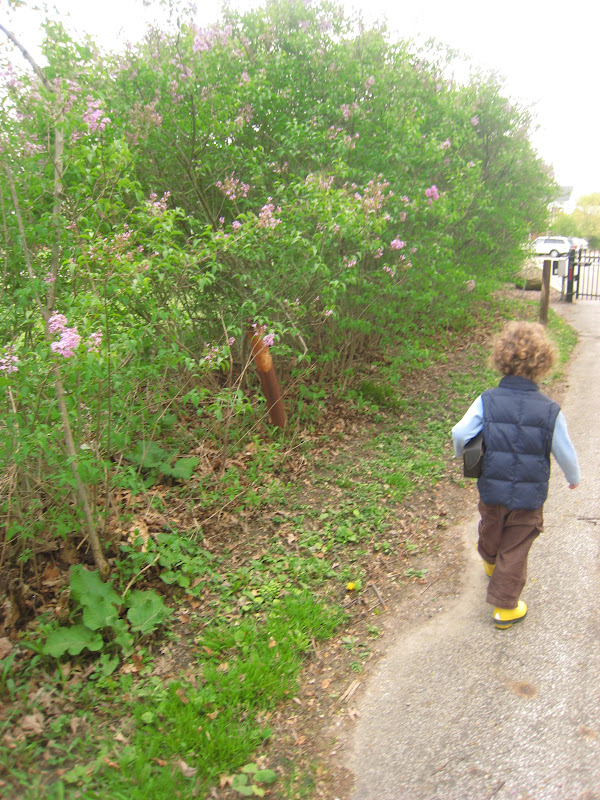
to a place called Lilac lane ...
with a boy who brought his scissors (and a feather-collecting box)...
that led to lilacs on my mantel.
And I love the lilacs, I do. But even more, I love it that my kids eagerly go collecting feathers and lilacs. I love it that Finn wants to wear his own bouquet--that he fills his pockets with flowers, and then stuffs them in his sweater's buttonholes. I love it that Willa will sit for hours in the dirt, tasting, drawing, sifting, exploring. And I love it that this is normal for kids--this is just what kids do. I want my children--all children--to love this world, to experience it as grace, a gift from God. I want them to walk on sturdy feet, knowing that they belong here and won't just float away. Finn said the other night, in his nightly prayers, "God, I like this world. Can you make more of it?" Indeed, I want them to know themselves as co-creators with God, participating in on-going creation. One of Finn's favorite preschool prayers goes "God pushed up the mountains, and rolled out the sea. He painted the skies and then made me." But we do it in the present tense at home--God pushes up the mountains, God makes me.
Of course, classic Christianity asserts that this world isn't our home, that we are but passing through, and that we shouldn't let our affections get tied up here. This theology, taken wrongly, can lead to all sorts of problems with wasting our resources and not caring for creation, but holding too tightly to this world leads to problems too.
Last week, a dear college friend came through town last-minute, sharing lunch with us and bringing morels. I didn't take many, since Matt would be away and I assumed my mushroom-shunning children wouldn't have anything to do with them. Finn, however, was intrigued with the idea that Josh foraged for them in the woods, and couldn't wait to try them. The smell drew him right up to the stove, and then at the table, he couldn't stop eating them, exclaiming over and over how delicious they were. And they were--rich and earthy, scented with a little garlic and a little thyme and a little dirt. At one point he stopped and said, "Josh must really love us to give us something so delicious."
More than anything, this is what I want for them: to know deep inside that God really loves them, to give them something so delicious as this world, and at the same time, to trust God enough to be able to let it go when the time comes.
4.19.2012
happiness is ...
...a boy newly confident on his scooter ...
...who will hop off said scooter at the sight of flowers...
...and then carefully pick and arrange those flowers into a bouquet...
...a bouquet not for his mama, but for his scooter.
...who will hop off said scooter at the sight of flowers...
...and then carefully pick and arrange those flowers into a bouquet...
...a bouquet not for his mama, but for his scooter.
Subscribe to:
Posts (Atom)


